I recently read Leo Tolstoy's classic novel Anna Karenina. In it I found this incredible passage which I wanted to share with you:
"Levin walked along the highroad with great strides, attending not so much to his own thoughts (he was still unable to disentagle them) as to a spiritual condition he had never experienced before.
The peasant's words had affected his soul like an electric spark, suddenly transforming and fusing into one a whole swarm of disjointed, impotent individual thoughts that had never stopped interesting him. These thoughts had occupied his mind, though he hadn't known it, even while he had been talking about letting the land.
He felt something new in his soul, and palpated this new thing with pleasure, not yet knowing what it was.
To live not for one's needs, but for God. For what God? And what could you say that was more senseless than what he said? He said it was unnecessary to live for one's own needs; that is, it's not necessary to live for what we understand, for what we're drawn to, for what we want, but we must live for something incomprehensible, for God which no one can understand or define. Well, and what of it? Didn't I understand those senseless words of Theodore's? And after I understood did I have any doubt of their truth? Did I find them stupid, obscure, inexact?
No, I understood them, just as he understands them; I understood them completely, and more clearly than I understand anything in life; I've never doubted it in my life, nor can I doubt it. And not I alone, but everyone, the whole world understands this alone completely, it's the only thing it has no doubt of and always agrees with.
Theodore says that Kirilov the house porter lives for his belly. That's understandable and rational. As rational creatures none of us can live in any other way than for our bellies. Then suddenly this same Theodore says living for your belly is bad, and that you have to live for the truth, for God, and I understand him from a mere hint! And I and millions of people who lived ages ago and are living now, peasants, the poor in spirit, and wise men who've thought and written about this, and said the same thing in their unclear way - we all agree on this one thing: what we should live for, and what it is that's good. There's only one thing I , together with everyone, know with certainty, know clearly and beyond question, and this piece of knowledge cannot be explained by reason - it is beyond that; it has no causes and can have no consequences.
If goodness has a cause, it is no longer goodness; if it has a consequence it is also not goodness. Consequently, goodness is outside the chain of cause and effect.
It is just this that I know, and that we all know.
And I had been seeking miracles; I regretted not having seen a miracle that would have convinced me. And here is a miracle, the only possible one, everlasting, surrounding me on all sides - and I never noticed it!
What miracle can be greater than that?
Can I really have found the solution of everything? Can my suffering really be over now? thought Leving, striding along the dusty road, unaware of either the heat or his fatigue, and with a feeling of relief after long-drawn-out suffering. This feeling gave him so much joy it seemed to him improbable. He was panting with excitement; incapable of walking any farther he left the road for the woods, and sat down on the uncut grass in the shade of the aspens. He took his hat off his sweating head and lay down, leaning on his elbows in the juicy, feathery forest grass.
Yes, I must think it through and clear things up, he thought, staring intently at the untrodden grass before him, and watching the movements of a little green beetle that was climbing up a stalk of couch grass and being hindered by a leaf of goutwort. Let's start all over again, he said to himself, turning aside the leaf of goutwort so that it wouldn't be in the beetle's way, and bending down another blade of grass for the beetle to pass on to. What is making me so happy? What have I discovered?
Before I used to say that in my body, in the body of this grass and of this beetle (there, he didn't want that blade of grass, it's spread its wings and flown away) a certain transformation of matter was accomplished in accordance with physical, chemical, and physiological laws. And in all of us, including the aspens, the clouds, and the misty nebulaein space, evolution takes place. Evolution from what? Into what? Infinite evolution and struggle? As though there could be any direction or struggle in the infinite! And I was astonished that in spite of the greatest mental concentration along those lines the meaning of life was not revealed to me, the meaning of my impulses and my aspirations. Whereas the meaning of my impulses is so clear to me that I live by them constantly, and I was astonished and overjoyed when a peasont expressed it to me: to live for God, for the soul.
I've discovered nothing. I've simply learned what I knew already. I've understood the force that gave me life not in the past alone, but is giving me life at this very moment. I've liberated myself from deception; I've learned to know my Master.
He summarized to himself the whole course of his thinking during the preceding two years, the beginning of which had been a clear, obvious thought about death at the sight of his beloved brother hopelessly ill.
At that time, having understood clearly for the first time that for every human being and for himself nothing lay ahead but suffering, death, and eternal oblivion, he decided that it was impossible to live that way, that he either had to interpret his life in such a way that it did not seem to be an evil mockery on the part of some devil, or else shoot himself.
But he did neither one thing nor the other; he went on living, thinking, and feeling; he even married at just this time, had many joys, and was happy whenever he wasn't thinking about the meaning of his life.
What did that mean? It meant he was living well but thinking badly.
He was living (without being aware of it) in accordance with the spiritual truths he had drunk in with his mother's milk, but he was thinking not only without acknowledging these truths but taking pains to evade them.
Now it was clear to him that he could live only thanks to those beliefs in which he had been brought up.
What would I be, how would I have lived my life, if I had lacked those beliefs? If I hadn't known you had to live for God and not for your own needs? I should have robbed, lied, murdered. None of the things that constitute the chief joys of my life would have existed for me. And though he made the greatest effort of the imagination he could nevertheless not picture to himself the bestial creature he himself would have been if he hadn't known what he was living for.
I was looking for an answer to my question. But thinking could not give me any answer to my question - it is not commensurate with it. It was life itself that gave me the answer, through my knowledge of what is good and what is bad. And I didn't acquire this knowledge in any special way; it was given to me just as it is to everyone - given just because I couldn't have gotten it anywhere.
Where did I get it from? Was it through reason that I managed to see that you had to love your neighbor and not throttle him? I was told that as a child, and I was glad to believe it because what was told me was what I already had in my soul. But who discovered it? Not reason. Reason discovered the struggle for existence and the law requiring anyone who interfered with the satisfaction of my desires to be throttled. That is a deduction made by reason. But it was not reason that could have discovered love of one's fellows, because that is unreasonable.
"Levin recalled a recent scene with Dolly and her children. The children, who had been left alone, had begun cooking raspberries over candles and squirting jets of milk into their mouths. Their mother, who had caught them in the act, tried to impress on them in front of Levin how much work it had taken the grown-ups to make what they were destroying, that the work had been done on their behalf, and if they broke the cups they wouldn't have anything to drink tea out of, and if they spilled the milk they wouldn't have anything to eat and would die of hunger.
And Levin was struck by the stolid, weary skepticism with which the children listened to what their mother was telling them. They were only annoyed that their absorbing game had been stopped, and didn't believe a word of what she was saying. Nor could they have believed, since they were unable to imagine the full volume of everything they made use of, and so could not realize that what they were destroying was the same as what they lived on.
All that comes about by itself, they thought, and there's nothing the least bit interesting or important about it, because it's always been that way and always will be. It's always the same thing over and over again. There's no reason for us to think about it, it's all there ready for us; what we want is to think up something of our own, something novel. Now there we thought up the idea of putting raspberries into a cup and cooking them over a candle and squirting the milk into each other's mouth. That's something novel, it's fun and not in the least worse than drinking out of cups.
Don't we do the same thing, didn't I do the same thing when I was using reason to look for the meaning of the forces of nature and the point of human existence? Levin went on thinking.
And don't all philosophical theories do the same thing when they embark on ways of thought strange and alien to man in order to lead him to a knowledge of what he's known for a long time, and knows with such certainty that he couldn't even go on living without it? Isn't it obvious and clear in the development of every philosopher's theory that he starts off by knowing just as unquestionably as the peasant, Theodore, and not in any way more clearly, the cardinal meaning of life, and simply wants to take a dubious intellectual path in order to return to what everyone knows?
Well then, what if the children were left alone to get hold of or manufacture cups for themselves, milk the cows, and so on? Would they start any mischief? They would just die of hunger. And suppose we were left with all our nonsense and ideas, with no conception of the one God, the Creator! With no conception of what goodness is, no explanation of moral evil!
Just try to build anything without these conceptions!
We destroy because we are spiritually sated. We're just children after all!
Where did I get the joyful knowledge I have in common with the peasant, which is the only thing that gives me any peace of mind? Where did I get it?
I who have been brought up in the conception of God, as a Christian, and have filled my whole life with those spiritual blessings given me by Christianity, overflowing with these blessings and living by them, I too am a destroyer just like the children, that is, I want to destroy what I live by. And the moment an important moment in life comes, just like the children when they're cold and hungry, I go to Him, and I feel even less than the children when they're scolded by their mother for their childish mischief than my own childish attempts at wanton madness should be reckoned against me.
Yes - what I know I don't know by reason, it has been given to me, disclosed to me, and I know it by my heart, and by my faith in the chief things taught by the Church.
The Church? The Church! Levin repeated to himself, turning over on the other side; leaning on his elbow he began gazing into the distance at a herd of cattle that were going down to the river along the farther side.
But can I believe in everything taught by the Church? he thought, testing himself by thinking up everything that might destroy his present peace of mind. He deliberately began recalling all the doctrines of the Church that had always seemed to him the most strange and used to put him off. The Creation? But how did I explain existence? By existence? By nothing? The Devil, sin? But how do I explain evil? Atonement?
But I know nothing, nothing, and there's nothing I can know except what is told to me as to everyone.
And now it seemed to him that there was not a single one of the beliefs of the Church that disturbed the chief thing - faith in God, in goodness, as the sole purpose of mankind.
Every doctrine of the Church could be led back to the belief in the service of the truth rather than of personal needs. And each one would not only not disturb that, but was necessary for the consummation of the principal miracle constantly being manifested on earth, which consists in enabling every individual, in common with millions of the most diverse human beings, sages and fools, children and graybeards - everyone, the peasant, Lvov, Kitty, paupers and kings - to understand beyond question one and the same thing, and to live that life of the spirit that is the only thing worth living for and the only thing we cherish.
Lying on his back now he gazed high up into the cloudless sky. Don't I know that to be infinite space, and not a rounded vault? But no matter how I screw up my eyes and strain my eyesight I cannot help seeing it as rounded and limited, and in spite of my knowledge of its being infinite space I'm undoubtedly right in seeing it as a firm blue vault; I'm more right than when I strain to see beyond it.
Levin had stopped thinking now and was merely listening in as it were to mystic voices that seemed to be carrying on a gay and earnest discussion of something.
Can this be faith? he thought, afraid to believe in his happiness. 'I thank Thee, my God!' he murmured, gulping down the sobs that were rising within him, and with both hands wiping away the tears that filled his eyes.
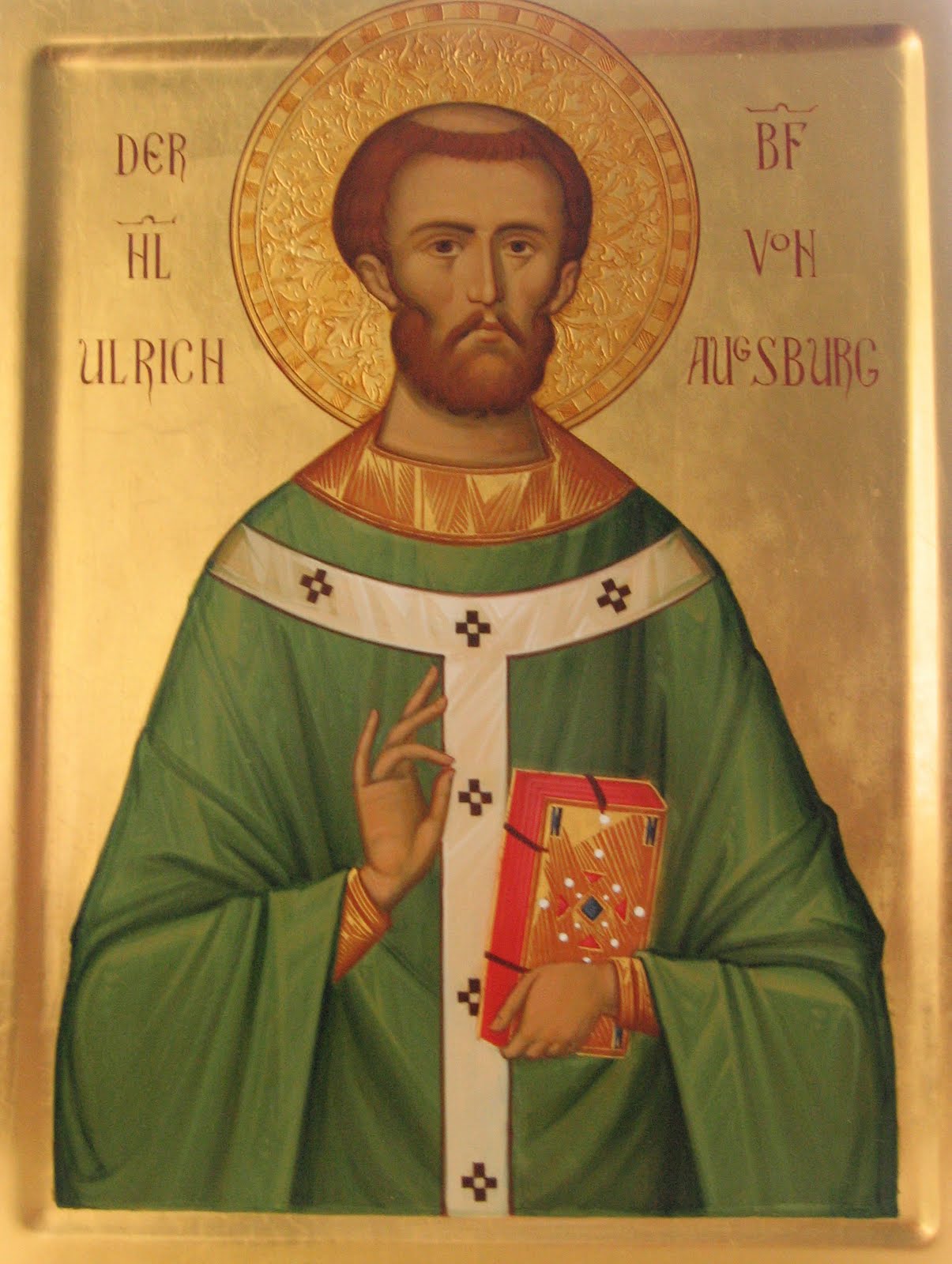 St. Ulric was born in 890 A.D. at Kyburg, Zurich, Switzerland. His father was Count Hucpald through whom Ulric was related to the dukes of Alamannia and the imperial family.

 Did you know that in the Church every day is a feast day? That's right, each day of the year is the feast of at least one saint. So I've decided that I'm going to start doing a daily feature on the saint of the day. Today - St. Thomas the Apostle.


