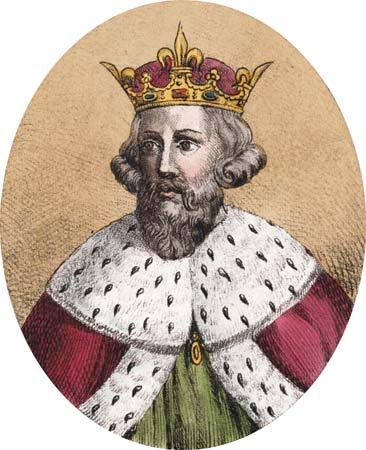
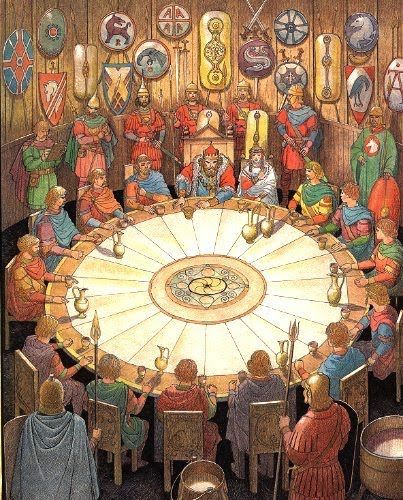
Last year I came across a list of 100 Books Every Woman Should Read. So I began to read them. And I've decided that I'm going to start doing reviews of each of them on here as I finish. The asterisks next to the book title in the heading represent my rating of the book out of a total of 4 stars (or, in this case, asterisks). Oh, and just because it's a list of books every woman should read doesn't mean men can't read them too (though you can find a list of 100 Books Every Man Should Read
here). And so we begin today with Le Morte D'Arthur.
Here's what The Complete Woman Blog has to say about the book: "
And speaking of Malory . . . his compendium of Arthurian lore is a classic and well worth reading. It is commonly known as Le Morte D'Arthur or "The Death of Arthur" but that is properly only the title of the final section. There is much to love about this book, not the least of which is its gorgeous Middle English prose."Le Morte D'Arthur translated literally means The Death of Arthur. Though technically only the title for the last section of the book, Le Morte D'Arthur has come to be used as the title for the entire collection of the tales of King Arthur. And no, I didn't read it in French, I'm not that talented.
I began reading Le Morte D'Arthur with the typical idea of knights in shining armor and suchwhat. Unfortunately, for the first 14 books of the volume I found myself sadly misled. The morality of these 14 books was incredibly screwed up. A common frustration was knights committing particularly agregious adulteries but then making a point of stating that they were daily Communicants. It was not until the entrance of Sir Galahad and the quest for the Sangreal that any legitimate morality or theology appeared. Unfortunately, though always nice, the religious tales were not always theologically correct. In addition to all this there is a significant demonization, throughout the book, of the "old law," meaning the thousands of years of Judaism prior to Christ. Well now isn't that dumb. Y'know considering that Christ WAS Jewish and said Himself in regards to the law that "I come not to abolish, but to fulfill." I really have nothing to add to that.
So, now, under the good points of the book we find a plethora of excellent quotes (mostly from  the quest for the Sangreal) which I will allow to speak for themselves (for the most part):
- Sir Launcelot's recognition of his sin was one of the highlights of the book: "My sin and my wickedness have brought me unto great dishonour. For when I sought worldly adventures for worldly desires, I ever enchieved them and had the better in every place, and never was I discomfit in no quarrel, were it right or wrong. And now I take upon me the adventures of holy things, and now I see and understand that mine old sin hindereth me and shameth me, so that I had no power to stir nor speak when the Holy Blood appeared afore me."
- The book also contains a fantastic explanation of why we cannot receive the Eucharist while in a state of mortal sin: "And for your presumption to take upon you in deadly sin for to be in His presence, where His flesh and His blood was, that caused you ye might not see it with worldly eyes; for He will not appear where such sinners be, but if it be unto their great hurt and unto their great shame; and there is no knight living now that ought to give God so great thank as ye, for He hath given you beauty, seemliness, and great strength above all other knights; and therefore ye are the more beholding unto God than any other man, to love Him and dread Him, for your strength and manhood will little avail you an God be against you." The Sangreal (or Holy Grail) helps to emphasize this point in the book, however it is something that we need to be aware of every time we receive the Eucharist at Mass.
- There is a beautiful story told of King Solomon and the Virgin Mary (it's not actually
 Biblical but the message is true): "This Solomon had an evil wife, wherethrough he weened that there had been no good woman, and so he despised them in his books. So answer a voice him once: Solomon, if heaviness come to a man by a woman ne reck thou never; for yet shall there come a woman whereof there shall come greater joy to man an hundred times more than this heaviness giveth sorrow; and that woman shall be born of thy lineage. Tho when Solomon heard these words he held himself but a fool and the truth he perceived by old books. Also the Holy Ghost showed him the coming of the glorious Virgin Mary."
- I absolutely loved this one: "For if they misdid against God, the vengeance is not ours, but to Him which hath power thereof." I mean, it's pretty much taken straight from the Bible so you know it's good.
- Le Morte D'Arthur also contains a superb argument against euthanasia: "In the name of God, said an old man, for I do you verily to wit he is not dead, but he is so full of life as the mightiest of you all; and therefore I counsel you taht he be well kept till God send him life again." Basically, until they actually die, we never really know if a person will recover. For example, I remember reading about a woman who was in a coma for sixteen years and then recovered. I'm sure there have been people who have been in a coma longer than that and recovered. What it comes down to is: it's not our job to decide when people die! God will take a person home when it's their time and if we start fooling around with death we're gonna make some serious errors.
- Sir Galahad displays sanctity throughout his adventures but never more so than in this passage which gives an excellent explanation of the glory of God: "And Galahad fell in his prayer long time to Our Lord, that at what time he asked, that he should pass out of this world. So much he prayed till a voice said to him: Galahad, thou shalt have thy request; and when thou askest the death of thy body thou shalt have it and then shalt thou find the life of the soul. Percivale heard this, and prayed him, of fellowship that was between them, to tell him wherefore he asked such things. That shall I tell you, said Galahad; the other day when we saw a part of the adventures of the Sangreal I was in such a joy of heart, that I trow never man was that was earthly. And therefore I wot well, when my body is dead my soul shall be in great joy to see the blessed Trinity every day, and the majesty of Our Lord, Jesu Christ."

- One aspect of this book that I absolutely love is a real understanding of the Eucharist and the Mass. Here are the best examples:
- "So came there out of a chamber a good man which was a priest and bare God's Body in a cup."
- "Then he looked up in the midst of the chamber, and saw a table of silver, and the Holy Vessel, covered with red samite, and many angels about it, whereof one held a candle of wax burning, and the other held a cross, and the ornaments of an altar. And before the Holy Vessel he saw a good man clothed as a priest. And it seemed that he was at the sacring of the Mass. And it seemed to Launcelot that above the priest's hands were three men, whereof the two put the youngest by likeness between the priest's hands; and so he lift it up right high, and it seemed to show so to the people."
- "And then he took an ubblie which was made in likeness of bread. And at the lifting up there came a figure in likeness of a child, and the visage was as red and as bright as any fire, and smote Himself into the bread, so that they all saw it that the bread was formed of a flshly man; and then he put it into the Holy Vessel again, and then he did that longed to a priest to do to a Mass."
It comes down to this: from the quest for the Sangreal to the end of the book is worth reading. The end, in fact, with it's tales of repentance and salvation, almost made the rest of the book worth it. Almost. I appreciate that the first 14 books were (somewhat) necessary backround information but they were immoral, tedious, and just an absolute chore to read. So I would give the end of the book 3 stars and the rest of it 1 star. So, to compromise, I give the book as a whole 2 stars. And my recommendation is: if you absolutely must read about King Arthur just read  from the entrance of Sir Galahad and the beginning of the quest for the Sangreal to the end. Skip all that other stuff, it's just not worth it.
Oh, I almost forgot, my very favorite part of the book was the note at the end from Sir Thomas Mallory, the translator, asking the reader to pray for him. If I ever wrote a book that's how I'd want to end it.
 St. Veronica was born in Italy in 1660, the daughter of the wealthy couple Francesco Giuliani and Benedetta Mancini. The child was baptised Ursula Giuliani. Her first words were spoken at the age of eighteen months when she said to a crooked merchant "Do justice, God sees you." At the age of three she began to receive visions from Our Lord. Throughout her youth she was known to be a pious child though she was prone to anger, especially when others did not readily join in her religious practices, at which times she could also become quite domineering. She finally recognized these imperfections when, at the age of sixteen, she received a vision of her own heart as a heart of steel. From then on she worked to correct these faults. She also confessed in her writings to a great pleasure in the worldly things which she enjoyed in her parents' home.
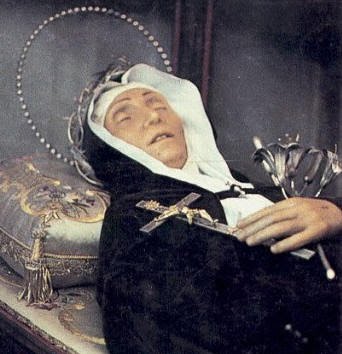 Despite her mystical experiences, Sister Veronica was known to be a highly practical woman. While serving as novice mistress in the convent she refused to allow the young women to read anything related to mysticism, "insisting that they become practical brides of Christ." Later, as abbess of her house, Sister Veronica enlarged the convent and had a system of water-pipes installed.


 Grimbald was born around 825 A.D. in Therouanne (Pas-de-Calais), France. He became a Benedictine monk around the year 840 and was ordained a priest in 870. Following his ordination, Grimbald was appointed abbot of Saint-Bertin.