Thursday, July 15, 2010

100 Books Every Woman Should Read - Sons and Lovers ***


"More about sons than lovers this novel clearly illustrates the potential tragedy of loving one's children too selfishly. A mother is discontent in her own marriage and sows discontent in her sons."

This book is a wonderful argument against pre-marital sex. It is also a good argument against hasty marriage, bad parenting, extramarital affairs, divorce, and general stupidity. It is so because it vividly portrays the consequences of these terrible choices.

The author (D.H. Lawrence) is an extremely good writer. I absolutely loved how he really put me inside the characters' heads. I knew exactly what their thoughts, experiences, feelings, emotions, motivations, and ideas were. It was really fascinating. I think anyone interested in psychology would love this book. The book is semi-autobiographical which is why the author was able to portray with such acute accuracy the thoughts and experiences of the characters; because they were, in fact, his own thoughts and experiences. (That said, from what I've heard of Lawrence's other books I would definitely NOT suggest reading them.)


I feel that I now better understand the people I know who come from broken homes. I don't understand them in the sense that I now condone the way they are living their lives but rather in the sense that I have a better understanding of their motivations and of how truly hurt they are. I also feel that I have a better understanding of exactly how being in a broken home affects the children and how a child's relationship with his/her mother and father individually affects the child. The book also really depicts the importance of fathers, by depicting what happens when they shirk their responsibilities. To paraphrase the great Professor Cassidy: the majority of people who have problems have father issues.


The book should get you to think, both about the issues that I mentioned above and about yourself and your own character flaws. Not a single character in this book was a truly good character. They were all substantially flawed.


I do have to say I was kind of disappointed with the ending. Most of the loose ends were tied up but the author left one big one hanging, namely, the main character's life. Nothing was resolved for him. The last sentence was something along the lines of: Paul walked down the street. The End. I felt like the book ended but the story didn't, it just stopped abruptly. This is probably because the book was semi-autobiographical and the author had not figured out his own life so he didn't have any answers to offer for the issues that he/the main character were dealing with, hence, he couldn't write a really satisfying ending.


This is definitely a sad book, my brother would even classify it as depressing. However, it does make a point, as opposed to just being mindless depression (however I would recommend doing something fun after reading it - like going to see Toy Story 3 which I highly recommend!).


Now, this book would definitely be rated PG-13 but I think it's worth reading. Just be warned that there are definitely some scandalous parts. There are some parts of the book that I would certainly have tweaked, but overall it was very good so I give it three stars.


Some good quotes:


1) "Why don't you be more manly? To do nothing but find fault with a girl and then pretend you're engaged to her!"


2) "She is like that, and if you choose her - well, you can't grumble."


3) "'You think she's a man-hater?' 'She thinks she is.'"


4) "He could not leave her, because in one way she did hold the best of him. He could not stay with her because she did not take the rest of him."


5) "She sort of wants me so much that I can't give myself."


6) [In speaking of their affair] "But is it me you want, or is it It?"


7) "He became, not a man with a mind, but a great instinct."

Saint of the Day - St. Bonaventure

St. Bonaventure was born in 1221 in Bagnoregio, Tuscany, Italy the son of Giovanni di Fidenza and his wife Ritella. St. Bonaventure was baptized Giovanni after his father. Legend states that, through the prayers of St. Francis of Assisi, young Giovanni was cured of a childhood illness.

At the age of 22 Giovanni entered the Franciscan Order of Friars Minar and took the name Bonaventure. The young friar was sent to Paris to complete his education. It was here that he first met St. Thomas Aquinas who would be a life-long friend. He also befriended King St. Louis IX for whom he composed an office of the Passion of Our Lord.

In 1257, the 35 year old Bonaventure was elected minister general of the entire Franciscan order. He was so succesful in this position that his brothers bestowed on him the title of "Second Founder" of the Friars Minor. In addition he was known to be an excellent preacher who also produced several written works such as his biography of St. Francis, Commentary on the Franciscan Rule, and Journey of the Soul to God.

Pope Gregory X raised Bonaventure to the stature of Cardinal and appointed him to the see of Albano (though the humble friar stubbornly protested that he did not desire these appointments).

St. Bonaventure was a moving force behind the Council of Lyons but died of natural causes on July 15, 1274, before the close of the Council. He was canonized on April 14, 1482 by Pope Sixtus IV. He is the patron saint: against intestinal problems; of Bagnoregio, Italy; of the Cochiti Indian Pueblo; and of St. Bonaventure University in New York.

Wednesday, July 14, 2010

Saint of the Day - St. Camillus de Lellis

Camillus de Lellis was born on May 25, 1550 at Bocchiavico, Abruzzi, in Naples, Italy. He was the son of army captain Giovanni de Lellis and his nearly sixty year old wife, Camilla Compelli de Laureto. Prior to her son's birth, Camilla had a dream of her son with a cross on his chest leading other men also bearing this cross. At this time the cross signified those who were condemned to death by hanging. The mother feared that her son would become the leader of a gang of criminals.

The mother died when Camillus was only thirteen, not living to see her son's reckless youth. The young man followed his father into the army where he received a leg wound that would torment him the rest of his life. His free time was mostly spent in gambling due to which he nearly fell into poverty.

His circumstances forced Camillus to take a job doing construction for the Capuchin friars. These holy men converted Camillus who, at the age of 25, "resolved to reform his life and dedicate himself to the service of God." He "entered the Capuchin novitiate three times" but, each time, a recurrence of his leg injury forced him to leave.

In search of better medical care Camillus departed for Rome where he met St. Philip Neri who became his confessor.

Camillus founded the Congregation of the Servants of the Sick which began as a small "group of good men willing to dedicate themselves to the sick." He led a veritable army of these Servants in fighting the plague and other epidemics sweeping Rome. All the Servants had a red cross emblazoned on the front of their black cassocks, thereby fulfilling the mother's dream.

Camillus studied for the priesthood and was ordained at the age of 24.

After a lifetime spent in service of the sick, Camillus himself fell ill and died on July 14, 1614 in Genoa, Italy of natural causes. He was canonized on June 29, 1746 by Pope Benedict XIV. Camillus de Lellis is the patron saint: against bodily ills; against illness; against sickness; of hospitals; of hospital workers; of nurses; and of sick people.

Tuesday, July 13, 2010

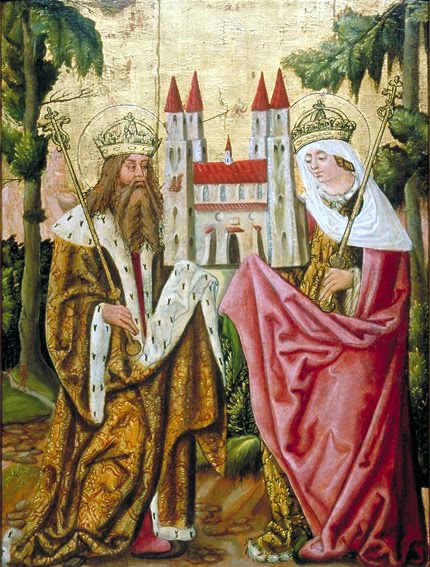
Saint of the Day - St. Henry II

Henry was born in 972 A.D. to Henry II (the Quarrelsome), Duke of Bavaria, and Gisella of Burgundy. He received an excellent education under the tutelage of Bishop Wolfgang of Regensburg at the Cathedral school in Hildesheim. Although he aspired to the priesthood, the death of Henry's father in 995 necessitated that he take upon himself the role of Duke of Bavaria, thereby foregoing his dreams of the priesthood. He was later crowned King of Germany in 1002 and King of Italy in 1004. In 1014 Pope Benedict VIII crowned Henry Holy Roman Emperor.

Henry was married to St. Cunegunda. They never had children and some accounts state that they had a celibate marriage but this can not be proven.

Henry was forced to do battle against his two brothers-in-law when they rebelled against him. Though they were defeated, Henry forgave them and the three were later reconciled.

Henry was involved in reform movements within the Church, while still respecting her independence. He made the city of Bamberg, Germany a center for missions to Slavic countries and began the construction of the Cathedral at Basel, Switzerland. Henry is said to have been cured of an unspecified illness by the touch of St. Benedict. Both he and St. Cunegunda were known to be prayerful and good to the poor.

After St. Cunegunda's death Henry desired to become a monk and sent his application to the abbey of Saint-Vanne at Verdun, France. The abbot refused his application however, telling him "to keep his place in the world where he could do much good for people and the advancement of God's kingdom."

Henry died on July 13, 1024 in Pfalz Grona, Saxony of natural causes. He was canonized by Pope Blessed Eugene III in 1146. He is the patron saint: against sterility; of the diocese of Bamberg, Germany; of Basel, Switzerland; of Benedictine Oblates; of childless people; of disabled people; of dukes; of handicapped people; of kings; of people rejected by religious orders; and of physically challenged people.

Monday, July 12, 2010

Saint of the Day - St. John Gualbert

John Gualbert was born in 985 A.D. in Florence, Italy, the son of Florentine nobility. Though he was raised in piety John had no sooner entered adult life than he grew attached to worldly pleasures. After the murder of his brother, Hugh, John, a soldier, hunted down the murderer with the intent to kill him. When, on Good Friday, John encountered his adversary, he had a vision of Christ on the Cross which he taook as a sign to pardon the man and return to Christianity. In answer to the man's cries for mercy John replied "I cannot refuse what you ask in Christ's name. I grant you not only your life, but my friendship. Pray that God may forgive me my sin!"

John then went in haste to a nearby abbatial church where he fervently prayed for Our Lord to forgive his sins. At this, the figure of Our Lord on the crucifix bowed its head toward John as if to signify that his request was granted.

Following this experience John, against the wishes of his family, joined the Benedictine order at San Miniato del Monte monastery. When the abbot of this monastery passed away the monks implored John to replace him but John fled rather than accept this position. He settled at the monastery of Vallombrosa which he had founded and built by hand. He also founded, and helped to build, abbeys at San Salvi, Moscetta, Rozzuolo, Monte Salario, and Passignano.

Many miraculous accounts surround St. John Gualbert's life. In one instance, his prayers are said to have multiplied the provisions of the monks during a time of famine so that they had enough grain to give to all the poor who came to them.

John was away when his enemies plundered the abbey of San Salvi and beat the monks. Upon his return, John said "Now you are true monks. Oh how I envy your lot!"

John died at Passignano, Italy of natural causes in 1073. He was canonized in 1193 by Pope Celestine III. He is the patron saint of: forest workers; foresters; park services; and parks.

Sunday, July 11, 2010

Saint of the Day - St. Benedict


St. Benedict was born in Nursia, Umbria, Italy, in 480 A.D. He and his twin sister, St. Scholastica, were born into a noble family. Benedict lived and studied in Rome throughout his youth. At some point during his teenage years (his exact age at the time is disputed) Benedict left Rome with his servant and settled for a short time in the city of Enfide with "a company of virtuous men." St. Benedict abandoned Enfide after performing his first miracle: the reparation of an earthenware wheat-sifter which his servant had broken. He was then so hounded by the local townspeople that he fled Enfide on his own for the small town of Subiaco.
It was at this time that Benedict first resolved to live the life of a poor laborer. He met, on his way to Subiaco, a monk by the name of Romanus. Romanus invested Benedict with the monk's habit and advised him to spend some time as a hermit. For three years Benedict lived in a secluded cave near a lake, unknown to all but Romanus whom he visited frequently.

By the end of these three years he had become known to neighboring peoples for his sanctity. When the abbot of a nearby monastary passed away the people begged Benedict to take his place. Though Benedict knew that the rule of the monastary differed greatly from his own ideas he was overcome by the entreaties of the people and agreed to their request. The experiment ended in the monks attempting to poison St. Benedict who then returned to his cave with a large group of followers.

For these followers Benedict built a total of twelve monastaries while keeping a few followers with him in the cave. Benedict, himself, was the abbot of all these. With the increasing notoriety of Benedict's monastaries came jealousy and persecution. In order to protect his followers from this Benedict left the cave for the town of Monte Cassino.

In this place Benedict destroyed a temple to the roman god Apollo and put an end to pagan and satanic practices. On the site of the temple Benedict built the oratory of St. Martin and an oratory of St. John. He then converted the people by his preaching and built a new monastery. It was most likely here that St. Benedict wrote his rule for monastic life.

St. Benedict died on March 21, 547 of a fever while praying at Monte Cassino. He is buried at Monte Cassino with his sister, St. Scholastica. Benedict was canonized by Pope Honorius III in 1220. He is the patron saint: against erysipelas; against fever; against gall stones; against inflammatory diseases; against kidney disease; against nettle rash; against poison; against temptations; against witchcraft; of agricultural workers; of cavers; of civil engineers; of coppersmiths; of dying people; of Europe; of farm workers; of farmers; of Heerdt, Germany; of Italian architects; of monks; of Norcia, Italy; of people in religious orders; of school children; of servants who have broken their master's belongings; of speliologists; of spelunkers; of students; and of Subiaco, Italy.

Prayer to St. Benedict

Glorious Saint Benedict, sublime model of virtue, pure vessel of God's grace! Behold me humbly kneeling at your feet. I implore you in your loving kindness to pray for me before the throne of God. To you I have recourse in the dangers that daily surround me. Shield me against my selfishness and my indifference to God and to my neighbor. Inspire me to imitate you in all things. May your blessing be with me always, so that I may see and serve Christ in others and owrk for His kingdom. Graciously obtain for me from God those favors and graces which I need so much in the trials, miseries and afflictions of life. Your heart was always full of love, compassion and mercy toward those who were afflicted or troubled in any way. You never dismissed without consolation and assistance anyone who had recourse to you. I therefore invoke your powerful intercession, confident in the hope that you will hear my prayers and obtain for me the special grace and favor I earnestly implore. {mention your petition} Help me, great Saint Benedict, to live and die as a faithful child of God, to run in the sweetness of His loving will, and to attain the eternal happiness of heaven. Amen.

Saturday, July 10, 2010

Saint of the Day - Sts. Rufina and Secunda

Sts. Rufina and Secunda were sisters in the Roman Empire, daughters of a man named Asterius from a senatorian family. The girls were promised in marriage to two Christian men. However, when the Valerian persecutions began both men abandoned their faith in fear. The sisters refused to follow their fiances example and fled Rome. They were captured, brought back to Rome, and tortured. They were then condemned by the prefect of Rome, one Junius Donatus, to death by beheading. The girls were brought to a place twelve miles outside of Rome called the Black Forest (Sylva Nigra) and executed. They were buried in the same place which began to be known as the White Forest (Sylva Candida) in honor of the two girls. Their martyrdom occured in 257 A.D.

A chapel was built over their grave which was later replaced, at the direction of Pope Damascus, by a large church. After a barbarian invasion, which destroyed the church, the relics of the saints were moved to St. John Latteran in Rome.